
Autonomous AI Agents
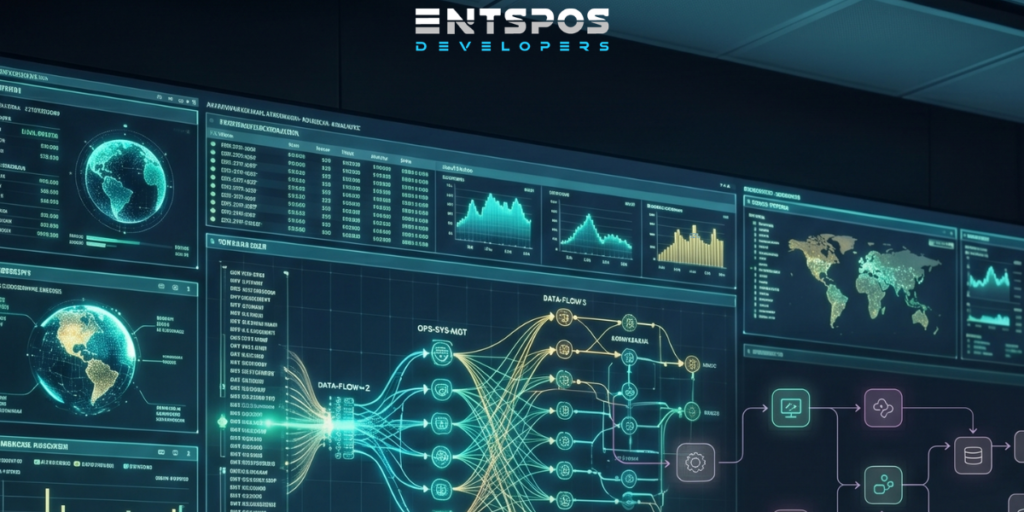
Nazima 11:40 am May 14, 2026 Meta’s Intelligent Ops Era: How Autonomous AI Agents Are Changing Business Operations A new wave of enterprise AI is moving beyond chatbots and assistants. Companies like Meta, Microsoft, Google, and OpenAI are now pushing toward “intelligent operations” — systems where AI agents don’t just suggest actions to employees, but actually complete operational tasks across business tools with limited human involvement. This shift could transform how organisations handle customer support, IT operations, hiring workflows, cybersecurity monitoring, internal analytics, and even product management. Businesses that adopt these systems effectively may gain major advantages in speed and operational efficiency. At the same time, the rise of autonomous AI introduces serious concerns around security, accountability, governance, and workforce adaptation. What Are Intelligent Ops? Intelligent operations, often shortened to intelligent ops, refer to AI-driven operational systems capable of executing business workflows autonomously. Unlike traditional AI assistants that only provide recommendations or generate text, intelligent ops platforms can: retrieve information from multiple systems, analyze context, make operational decisions, trigger workflows, interact with software tools through APIs, and complete tasks end-to-end. These systems typically combine several technologies together: Large Language Models (LLMs) Retrieval-Augmented Generation (RAG) Workflow orchestration engines API integrations Robotic Process Automation (RPA) Policy and permission layers Monitoring and observability systems The result is an AI agent that behaves more like a digital operator than a simple assistant. For example, instead of merely suggesting how to respond to a customer complaint, an intelligent ops system could: analyze the support ticket, retrieve customer history, identify the issue category, generate and send a response, escalate the case if needed, update CRM records automatically, and log the interaction for reporting. All of this can happen within seconds. Why Intelligent Ops Matter Right Now The rapid growth of enterprise AI infrastructure has made autonomous workflows more practical than ever before. Over the last two years, businesses have moved from experimenting with generative AI tools to deploying AI systems inside real operational environments. Cloud providers are now embedding agent frameworks directly into enterprise ecosystems, making adoption faster and cheaper. The biggest driver behind this trend is efficiency. Companies are under pressure to: reduce operational costs, improve response times, scale support systems, and handle increasing amounts of digital work without proportionally increasing headcount. Intelligent ops systems address these problems by automating repetitive, rules-based, and data-heavy workflows. Some of the most common enterprise use cases include: IT incident management Customer service automation Recruitment screening Fraud detection Content moderation Internal knowledge retrieval DevOps monitoring Compliance workflows Sales pipeline management Instead of employees manually switching between multiple platforms, AI agents can coordinate actions across systems in real time. This can significantly reduce: workflow delays, operational bottlenecks, repetitive administrative work, and human error. However, the technology also introduces new risks because these agents often gain direct access to sensitive systems and internal company data. The Current State of Intelligent Ops in 2026 As of mid-2026, enterprise AI adoption has accelerated rapidly across major technology ecosystems. Large platforms are integrating autonomous agent capabilities directly into: cloud infrastructure, productivity suites, developer environments, and enterprise collaboration tools. This means companies no longer need to build every AI workflow from scratch. Instead, they can deploy pre-built agent frameworks and customize them for their operational needs. At the same time, cybersecurity experts are raising concerns about several emerging risks: 1. Hallucinated Actions AI agents may generate incorrect outputs or execute unintended actions when context is incomplete or ambiguous. 2. Data Exposure Risks Agents connected to internal systems can unintentionally expose confidential information if permissions are poorly configured. 3. Privilege Escalation Improperly secured agents may become pathways for attackers to access sensitive systems. 4. Accountability Problems Legal and regulatory discussions are intensifying around liability: Is the company responsible? Is the software provider responsible? Or does accountability fall on the AI model developer? These questions remain largely unresolved in many jurisdictions. How Intelligent Ops Rollouts Usually Happen Most organisations do not move directly into full AI automation. Successful deployments usually follow a staged rollout process. 1. Proof of Concept Teams start with a narrow, high-impact workflow. Examples include: ticket classification, meeting summarization, or internal knowledge retrieval. At this stage, the AI mainly assists employees rather than acting independently. 2. Controlled Pilot The agent operates in supervised mode. Humans review: recommendations, generated actions, and workflow outcomes. The goal is to measure reliability and identify edge cases before expanding permissions. 3. Limited Deployment Once accuracy improves, the system receives restricted write access to selected tools or workflows. Companies add: observability dashboards, audit trails, and performance metrics. This phase focuses heavily on governance and safety. 4. Full Operational Automation Low-risk workflows become fully autonomous. Human involvement shifts toward: oversight, exception handling, and policy management. Critical or high-impact actions still typically require approval checkpoints. A Simple Intelligent Ops Architecture Most enterprise intelligent ops systems follow a layered architecture. Orchestration Layer Coordinates tasks and determines which tools or workflows the agent should trigger. Connectors and Tools Integrations with: CRM systems, cloud infrastructure, ticketing platforms, databases, analytics tools, and internal APIs. Retrieval and Context Layer Provides current business context using: vector databases, documentation repositories, policy libraries, and enterprise knowledge bases. Security and Governance Layer Handles: permissions, approval gates, audit logging, encryption, and compliance controls. Monitoring and Observability Tracks: agent actions, confidence scores, workflow outcomes, override frequency, and system drift. Security and Safety Best Practices Because autonomous agents interact directly with operational systems, security becomes one of the most important aspects of intelligent ops. Apply Least-Privilege Access Agents should only receive the minimum permissions necessary for their specific tasks. Short-lived credentials and scoped API access reduce exposure risk. Filter Inputs and Outputs Data entering the model should be sanitized to prevent prompt injection attacks or malicious instructions. Outputs should also be validated before reaching production systems. Keep Humans in High-Risk Decisions Critical actions such as: financial approvals, infrastructure changes, or legal decisions should still require human authorization. Maintain Detailed Audit Logs Every action should be traceable. Logs should include: prompts, tool calls, timestamps,
Challenges in API integration
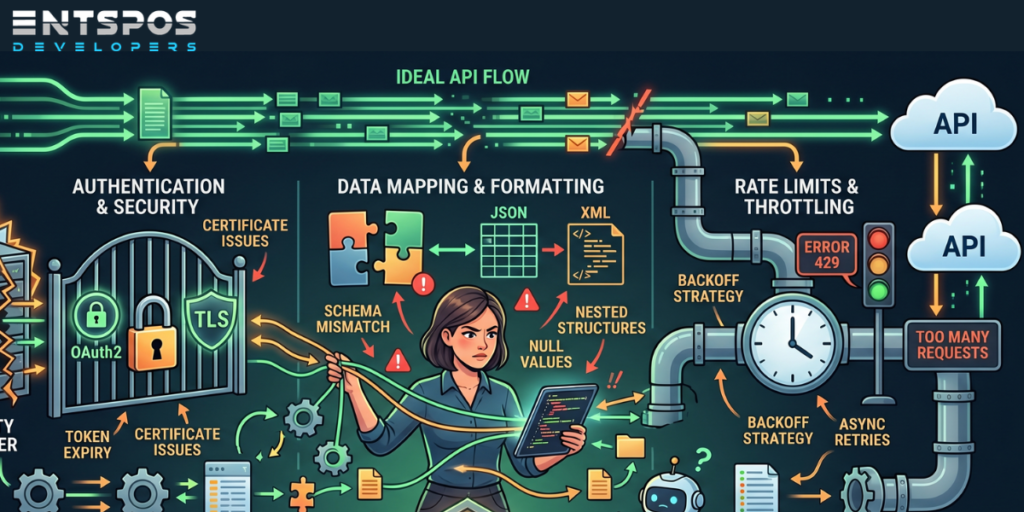
Nazima 6:31 pm May 11, 2026 One API Glitch, Zero Users: The Night We Lost 5,000 Signups It happened during a midnight deployment. Traffic was climbing fast. Signups were rolling in every second. Then suddenly—everything stopped. No crash screen. No dramatic server explosion. Just silence. Our third-party API integration had failed quietly in the background, and within minutes, nearly 5,000 new users were stuck in limbo. That night taught me something every developer, startup founder, and engineering team eventually learns: A product can have great code, a polished UI, and solid infrastructure—but weak API integration can still break the entire experience. After working with multiple teams and debugging integrations across different products, I’ve noticed the same problems appear again and again. Here are the biggest API integration challenges that cause real damage—and the fixes that actually work. 1. Authentication Problems That Break Everything Authentication failures are one of the most common integration issues, especially when multiple services are involved. A token expires unexpectedly. Permissions change. OAuth scopes mismatch. Suddenly every request starts returning 401 Unauthorized.Why this becomes a serious problem OAuth implementations differ between providers API keys and secrets get exposed or mismanaged Multi-tenant systems create permission confusion Refresh-token logic is often poorly handled What helped us We centralized authentication instead of handling it separately across services. Tools like Okta, Firebase Auth, or Auth0 simplify token management and role control. Adding middleware-level validation also helped us detect authentication failures before requests reached critical services. The result: authentication-related API errors dropped dramatically. 2. API Version Changes That Quietly Break Your App One of the most frustrating things about third-party APIs is that providers update them constantly. Sometimes an endpoint changes format. Sometimes a field disappears. Sometimes pagination behavior changes without warning. Your code keeps running—but your data becomes unreliable. Common versioning problems Breaking changes during active releases Legacy clients depending on old response structures Frontend parsing failures from modified payloads Different teams using different API versions Better approach Use explicit API versioning strategies such as: httpAPI-Version: 2.0 Contract-testing tools like Stoplight or Swagger/OpenAPI validation help ensure both teams follow the same schema expectations. Versioning discipline prevents “silent failures” that are hard to detect in production. 3. Rate Limits That Destroy Performance During Growth Most APIs look generous during development. Then launch day arrives. Suddenly your application exceeds quota limits, retries explode, and users start experiencing delays or failed actions. Why rate limits spiral out of control No monitoring of API quotas Aggressive retry loops multiplying requests Shared API keys across environments Confusion between per-user and global limits What works in production Redis caching for repeated requests Exponential backoff with jitter Queue systems for burst handling Monitoring tools like Prometheus or Grafana Caching alone can reduce external API costs and massively improve reliability under load. 4. Data Structure Mismatches That Waste Hours This is where integrations become exhausting. One API sends dates as timestamps. Another sends strings. Nested JSON structures differ slightly between environments. Nullable fields suddenly appear. Small inconsistencies create large debugging sessions. Typical causes Unannounced schema changes Mixed protocols like REST and gRPC Weak validation layers Inconsistent serialization formats Smarter solution Validate and normalize incoming data aggressively. Tools like: JSON Schema validators Zod tRPC TypeScript type enforcement …help catch issues before they spread into your application. Strong typing turns unpredictable integrations into maintainable systems. 5. Latency and Timeouts That Slowly Kill User Experience Not every failure is immediate. Sometimes APIs technically work—but they respond too slowly. A few extra seconds across multiple services can completely ruin application performance. What usually causes it Too many network hops Slow upstream providers Missing timeout configurations Serverless cold starts No circuit-breaker protection Better architecture choices Use gRPC where low latency matters Add request timeouts everywhere Implement circuit breakers Use reverse proxies like Envoy Example: javascriptfetch(url, {timeout: 5000}) Without proper timeout handling, slow services can consume resources indefinitely. 6. Reliability Problems From Third-Party Providers This is the harsh reality of modern software: Your application may be stable, but your dependencies might not be. Even providers promising “99.9% uptime” still experience outages, degraded performance, or regional failures. Hidden reliability risks No fallback providers Vendor lock-in Compliance conflicts across regions Regional API outages How teams reduce risk Add failover mechanisms Use API gateways like Zuplo Mirror critical services across cloud providers Design systems to degrade gracefully The goal is not perfect uptime. The goal is ensuring one provider failure does not take down your entire product. 7. Weak Testing That Lets Bugs Reach Production Many API integrations pass staging tests and still fail in real-world traffic. Why? Because mocks rarely behave exactly like production systems. Common testing gaps Outdated mock responses Missing edge-case payloads Unrealistic load simulations No contract testing between services Better testing stack WireMock for realistic API stubs Artillery or k6 for load testing Consumer-driven contract testing Chaos engineering practices One properly simulated failure scenario can prevent weeks of production damage. Final Thought: API Integration Is Infrastructure, Not Glue Code A lot of teams treat integrations like a secondary task. But APIs are no longer just connectors between services—they are part of your product’s core infrastructure. The strongest applications are not the ones with the most features. They are the ones that remain reliable when authentication fails, providers change behavior, traffic spikes, or dependencies go down. If you improve even one area today—authentication, testing, versioning, monitoring, or resilience—you reduce the chance of your next deployment turning into a disaster. Because in modern software, users rarely see the API. But they always feel it when it breaks. Recent Posts
Europe’s Digital Sovereignty Push and France’s Shift from Windows to Linux

Nazima 5:16 pm May 8, 2026 Europe’s Digital Sovereignty Push and France’s Shift from Windows to Linux Europe’s conversation around digital sovereignty has evolved rapidly in recent years. What once sounded like a political ambition is now becoming a practical strategy across the European Union. France’s decision to expand Linux adoption across government institutions is one of the clearest examples of this transformation. The broader objective is simple: European governments want greater authority over the technologies that power their public services, data systems, and digital infrastructure instead of relying heavily on foreign technology companies. At the center of this strategy is the belief that critical government systems should remain under European legal and technical control. Many policymakers argue that depending too much on foreign software vendors—particularly large American firms such as Microsoft, Google, and Amazon—creates long-term risks involving data governance, cybersecurity, and national autonomy. Understanding Digital Sovereignty Digital sovereignty refers to a nation’s ability to manage and protect its own digital ecosystem. This includes government data, communication platforms, cloud infrastructure, operating systems, and software tools. European governments increasingly want systems that operate according to EU regulations and remain independent from foreign legal influence. One major concern comes from laws such as the U.S. Cloud Act, which can allow American authorities to request access to data controlled by U.S.-based companies, even if the data is physically stored within Europe. Because of this, several European governments believe that depending entirely on foreign providers may expose sensitive information to legal and geopolitical risks. As a result, open-source technology has gained significant attention within Europe’s public sector. Open-source platforms allow governments to inspect source code, customize systems, and maintain greater transparency. Unlike proprietary software ecosystems, open-source solutions can be modified and audited internally, making them attractive for administrations that prioritize long-term independence and security. France’s Linux Migration Strategy France has become one of the leading examples of this digital sovereignty movement. In 2026, the country’s Interministerial Directorate for Digital Affairs (DINUM) accelerated plans to reduce dependence on non-European technology platforms. Ministries were instructed to evaluate their reliance on foreign software providers and prepare strategies for alternative solutions. The migration effort extends beyond operating systems. France is examining collaboration platforms, cloud infrastructure, communication services, and even AI-related tools. Particular attention is being given to services commonly associated with U.S. technology ecosystems, including Microsoft 365, Zoom-style communication platforms, and foreign cloud providers. Reports indicate that more than 100,000 government computers in France are already operating on Linux-based systems. What was once viewed as a specialized or experimental approach is now becoming part of mainstream government infrastructure. France is also investing in sovereign communication tools. One example is Visio, an encrypted video-conferencing platform designed for public-sector use. The goal is to provide government agencies with a secure alternative to platforms such as Microsoft Teams and Zoom while ensuring communications remain aligned with European standards and regulations. Officials expect broader deployment of Visio across public institutions over the next few years. Why Linux Fits Europe’s Sovereignty Goals Linux plays a central role in Europe’s sovereignty ambitions because of its open-source nature. Governments can examine the underlying code, audit system behavior, and verify security mechanisms without relying solely on assurances from a private vendor. This level of transparency is especially important in sectors involving defense, energy, intelligence, and public administration. Another advantage is the reduction of vendor lock-in. Proprietary ecosystems often tie organizations to a single company’s licensing model, upgrade schedule, and cloud infrastructure. Linux-based environments offer more flexibility because governments can work with multiple service providers, maintain internal expertise, or adapt systems according to national requirements. Europe is also supporting the development of sovereign Linux distributions tailored specifically for government use. These projects aim to create secure, standardized operating systems suitable for public institutions while still allowing local customization. Many of these initiatives are built on established open-source foundations and emphasize long-term stability, compliance, and security. A Broader European Movement France is not acting alone. Across Europe, governments are exploring ways to strengthen technological independence and reduce strategic dependence on external providers. In 2025, France and Germany jointly hosted a European Digital Sovereignty Summit in Berlin. Representatives from multiple EU member states discussed shared approaches to AI governance, public-sector infrastructure, cybersecurity, and data management. The summit led to a coordinated roadmap focused on sovereign cloud systems, transparency standards, and open-source adoption. Later, EU member states endorsed a European Digital Sovereignty Declaration. Although the declaration is not legally binding, it carries political significance by encouraging member states to diversify technology suppliers and invest in European alternatives for critical infrastructure. Several countries have already started experimenting with Linux and sovereign cloud initiatives. Germany and Denmark are expanding Linux use within government agencies, while Spain continues to support regional Linux projects. Other European countries are testing public-sector operating systems and cloud services designed to operate primarily within EU legal frameworks. At the EU level, discussions are ongoing about creating a common Linux-based platform for public institutions. Such a system could provide a shared technical foundation while still allowing individual countries to adapt features according to their own administrative needs. Security, Resilience, and Economic Benefits European leaders frequently describe security and resilience as major motivations behind the shift toward sovereign infrastructure. Governments want direct control over software updates, security patches, and system configurations. This can help reduce dependency on foreign vendors during geopolitical tensions or supply-chain disruptions. Privacy and data governance are equally important. Europe’s General Data Protection Regulation (GDPR) already sets strict standards for handling personal information. Combining GDPR policies with sovereign cloud infrastructure and Linux-based systems may make it easier for governments to maintain compliance and demonstrate accountability. There is also an economic dimension to the strategy. By encouraging public-sector adoption of Linux and open-source tools, European governments hope to strengthen domestic technology industries. Increased demand for local cloud providers, cybersecurity firms, software integrators, and open-source specialists could support the growth of a more independent European digital economy. Challenges Facing the Transition Despite strong political support, the transition away
Your Code Has a Personality: What Your Programming Style Says About You

Nazima 5:21 pm May 4, 2026 Your piece is already strong in structure and ideas, but it *does* sound a bit “AI-polished” and includes claims that feel generic or loosely sourced. I’ll rewrite it to sound more natural, grounded, and original—while keeping your core idea intact and removing anything that risks sounding copied or over-claimed. Your code doesn’t just solve problems—it quietly reflects how you think. Look closely at any developer’s work and you’ll start noticing patterns. The way they name variables, structure functions, or even leave comments isn’t random. Over time, these habits form a kind of signature. Not a perfect personality test, but definitely a set of clues about how someone approaches problems, teamwork, and even pressure. The Meticulous Architect Some developers write code that feels almost guided. Everything is neatly structured, and comments explain not just *what’s happening*, but *why it was done that way*. This kind of style usually comes from someone who thinks ahead. They’re not just writing code for today—they’re writing it for the next person who has to read it (which is often their future self). You’ll often see this in large teams or long-term projects where maintainability matters more than speed. What it suggests: someone patient, detail-oriented, and careful about decisions. The downside? They might spend more time polishing than necessary, especially on simple tasks. The Speed-First Coder On the opposite end, some code is stripped down to the essentials. Minimal comments, short variable names, and quick solutions that get the job done fast. This style is common in fast-moving environments—hackathons, startups, or competitive programming. The goal here isn’t perfection; it’s momentum. What it suggests: confidence and quick thinking. These developers trust their instincts and move fast. But when someone else has to maintain that code later, things can get… complicated. Functional Thinker Then there are developers who aim for clean, predictable logic. Their code avoids unnecessary changes in state, leans toward smaller reusable functions, and often follows functional programming ideas. It’s less about speed and more about correctness and clarity of logic. Everything is intentional. What it suggests: someone who values structure and deeper reasoning. They tend to think in systems rather than quick fixes. The trade-off is that their code can sometimes feel abstract or harder for others to follow at first glance. The Storyteller Some developers write code that almost reads like a narrative. Variable names are long but meaningful, spacing is intentional, and the flow feels easy to follow. Instead of relying heavily on comments, they make the code itself explain what’s happening. What it suggests: strong communication skills and empathy for others reading the code. They care about clarity, especially in team environments. The only risk is going too far—overly long names or excessive structure can slow things down. The Wild Card And then there are developers who don’t stick to any one style. Their code might mix conventions, include personal quirks, or experiment with unconventional approaches. This isn’t always a bad thing—some of the most creative solutions come from people who don’t follow strict rules. What it suggests: curiosity and creativity. They’re willing to try new things and break patterns. But without some consistency, collaboration can become difficult. So, What Does It All Mean? Coding style isn’t fixed. It changes with experience, team culture, and the kind of problems you’re solving. Someone might write fast, messy code under pressure, but switch to a cleaner, more structured style in long-term projects. The real takeaway isn’t to label styles as “good” or “bad.” It’s to be aware of your own habits. Do you optimize for speed or clarity? Do you write for yourself or for a team? Do you prioritize structure or flexibility? The best developers aren’t locked into one style—they adapt. They know when to move fast and when to slow down, when to simplify and when to explain. In the end, your code is less like a fixed fingerprint and more like a reflection of how you think in that moment. And that’s something you can keep refining over time. Recent Posts
AI + Blockchain for Threat Intelligence

Nazima 6:28 am May 2, 2026 AI + Blockchain for Threat Intelligence The combination of artificial intelligence and blockchain is transforming threat intelligence by enabling secure, decentralized data sharing and advanced threat detection capabilities. Key ConceptsThreat intelligence gathers and analyzes data on cyber threats such as malware, phishing attacks, and advanced persistent threats. AI improves this process with machine learning for real-time anomaly detection and predictive modeling. Blockchain adds immutability and decentralization, ensuring tamper-proof storage and verification without central vulnerabilities. Detailed AnalysisAI in Threat DetectionAI uses techniques like federated learning, where devices train models locally to spot patterns without exposing raw data. Models such as LightGBM and CNN-LSTM deliver high accuracy in classifying intrusions and anomalies. This approach preserves privacy while outperforming traditional centralized systems. Blockchain’s Security LayerBlockchain employs hybrid consensus mechanisms, like Proof-of-Stake combined with reputation scores, to validate threat data efficiently. Privacy tools including zero-knowledge proofs and homomorphic encryption allow verification without revealing sensitive details. Together, they create a trusted network for intelligence sharing. Integrated FrameworkThe synergy lets AI process blockchain-stored data for threat correlation, while blockchain secures AI model updates. This overcomes silos in platforms like MISP, enabling collaborative defense across organizations. Latest TrendsIn 2025-2026, multi-agent AI systems predict full attack lifecycles, paired with blockchain for verifiable IoT intelligence. Frameworks like BlockIntelChain lead in decentralized sharing for security operations centers. Generative AI now enriches reports, with blockchain logging to combat surging ransomware. Advantages & LimitationsThis integration raises detection rates above 94%, cuts response times to under a second, and ensures full audit trails. It promotes trustless collaboration ideal for global threat sharing. Challenges involve heavy computation for privacy proofs, energy demands in consensus, and chain interoperability issues. Real-World ApplicationsBlockIntelChain powers SOCs and IoT for real-time sharing, outperforming legacy platforms in privacy and cost. In critical sectors like healthcare, it blocks ransomware before encryption; financial firms use it for smart contract verification. Crypto investigators leverage blockchain intel for tracing illicit funds. ConclusionAI and blockchain build robust, proactive threat intelligence systems, vital for countering 2026’s sophisticated AI-powered attacks through privacy-focused, decentralized resilience. Recent Posts