
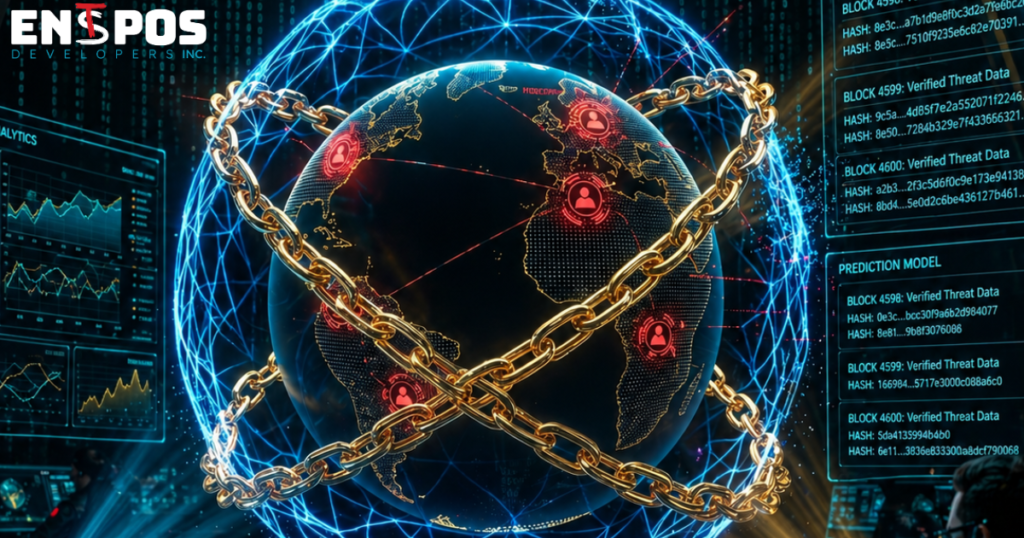
AI + Blockchain for Threat Intelligence
The combination of artificial intelligence and blockchain is transforming threat intelligence by enabling secure, decentralized data sharing and advanced threat detection capabilities.
Key Concepts
Threat intelligence gathers and analyzes data on cyber threats such as malware, phishing attacks, and advanced persistent threats. AI improves this process with machine learning for real-time anomaly detection and predictive modeling. Blockchain adds immutability and decentralization, ensuring tamper-proof storage and verification without central vulnerabilities.
Detailed Analysis
AI in Threat Detection
AI uses techniques like federated learning, where devices train models locally to spot patterns without exposing raw data. Models such as LightGBM and CNN-LSTM deliver high accuracy in classifying intrusions and anomalies. This approach preserves privacy while outperforming traditional centralized systems.
Blockchain’s Security Layer
Blockchain employs hybrid consensus mechanisms, like Proof-of-Stake combined with reputation scores, to validate threat data efficiently. Privacy tools including zero-knowledge proofs and homomorphic encryption allow verification without revealing sensitive details. Together, they create a trusted network for intelligence sharing.
Integrated Framework
The synergy lets AI process blockchain-stored data for threat correlation, while blockchain secures AI model updates. This overcomes silos in platforms like MISP, enabling collaborative defense across organizations.
Latest Trends
In 2025-2026, multi-agent AI systems predict full attack lifecycles, paired with blockchain for verifiable IoT intelligence. Frameworks like BlockIntelChain lead in decentralized sharing for security operations centers. Generative AI now enriches reports, with blockchain logging to combat surging ransomware.
Advantages & Limitations
This integration raises detection rates above 94%, cuts response times to under a second, and ensures full audit trails. It promotes trustless collaboration ideal for global threat sharing.
Challenges involve heavy computation for privacy proofs, energy demands in consensus, and chain interoperability issues.
Real-World Applications
BlockIntelChain powers SOCs and IoT for real-time sharing, outperforming legacy platforms in privacy and cost. In critical sectors like healthcare, it blocks ransomware before encryption; financial firms use it for smart contract verification. Crypto investigators leverage blockchain intel for tracing illicit funds.
Conclusion
AI and blockchain build robust, proactive threat intelligence systems, vital for countering 2026’s sophisticated AI-powered attacks through privacy-focused, decentralized resilience.