
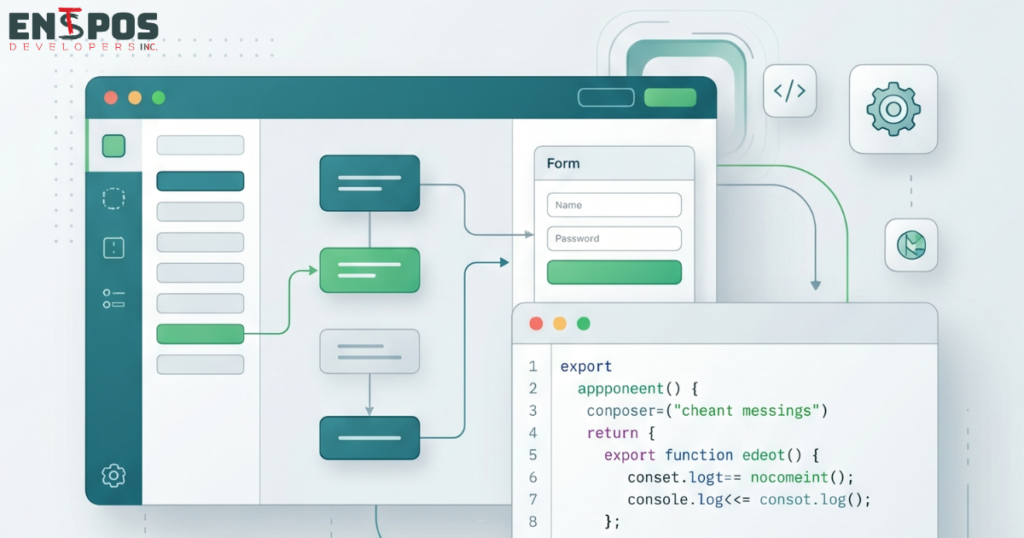
The Rise of Low-Code & No-Code: Opportunity or Threat for Developers?
Imagine launching a customer portal in weeks, not months—without hiring a full dev team. That’s the promise powering the low-code and no-code revolution. In 2026, these platforms aren’t niche experiments; they’re reshaping how businesses build software. Tools like Bubble, Airtable, and Webflow have democratized app development, letting non-technical teams create MVPs, automate workflows, and scale operations. But for developers, this shift sparks a burning question: opportunity or existential threat?
What Are Low-Code and No-Code, Anyway?
Low-code platforms provide visual interfaces, drag-and-drop builders, and pre-built components to minimize hand-coding. Think of them as accelerators: you write some code for tweaks, but most work happens through intuitive dashboards. No-code takes it further, eliminating code entirely—users assemble apps like digital Lego blocks using templates and logic flows.
Their surge stems from real pain points. Traditional coding demands specialized skills, long timelines, and hefty budgets. Low-code/no-code flips this: Gartner notes that by 2025, 70% of new apps used low-code tech (a trend holding strong into 2026). Popularity explodes because they deliver 10x faster builds, empowering “citizen developers”—marketers, ops leads, and founders—to innovate without waiting on IT.
Why Businesses Can’t Get Enough
Speed rules in today’s market. Startups need to iterate MVPs overnight to capture funding or users; SMEs want internal tools without draining cash reserves. Low-code/no-code delivers.
Consider a fintech startup in Lahore prototyping a payment dashboard on Adalo in days, testing market fit before custom coding. Or a mid-sized retailer using Zapier and Softr to automate inventory alerts, slashing ops costs by 40%. Enterprises like Siemens build employee portals on Mendix, freeing devs for core innovation. Accessibility shines too: no PhD in JavaScript required. These tools cut development costs by up to 70%, per Forrester insights, making software feasible for bootstrapped teams.
Opportunities Knocking for Developers
Far from sidelining coders, low-code/no-code elevates them. Developers gain superpowers for rapid prototyping—spin up proofs-of-concept in hours, validate ideas with stakeholders, then refine.
This shifts focus to high-value work: solving thorny problems like AI integrations or scalable architectures that platforms can’t touch. Take customization: a no-code CRM might handle basics, but devs layer in secure APIs for compliance-heavy industries like healthcare. Roles explode in integration—bridging OutSystems apps with legacy systems or optimizing performance. Forward-thinking devs become “platform architects,” commanding premiums (often 20-30% higher salaries) for orchestrating these ecosystems. It’s a career accelerator, not a dead end.
The Perceived Threat: Facing the Fears Head-On
Developers aren’t wrong to worry. Entry-level gigs for simple CRUD apps are drying up as no-code handles them effortlessly. A junior coder building basic forms now competes with a product manager using Glide. Platforms like Retool have automated routine tasks, potentially displacing rote coding jobs.
Yet limitations abound. No-code struggles with complexity: custom algorithms, real-time data processing, or high-traffic scalability demand traditional code. Security gaps emerge in visual builders—think unpatched vulnerabilities in third-party components. Vendor lock-in traps users: migrating from Bubble to custom code can cost more than starting fresh. When apps hit enterprise scale, like processing millions of transactions, low-code buckles without deep engineering. Traditional development remains king for mission-critical systems.
The Balanced Reality: Collaboration Wins
This isn’t replacement—it’s symbiosis. Low-code/no-code handles the “what” (quick builds), while developers tackle the “how” (robust, tailored execution). Picture a startup founder mocking up an app in Webflow, then handing it to a dev team for optimization. Hybrid teams thrive: 80% of enterprises now blend approaches, per McKinsey’s 2025 report.
Developers who adapt lead the charge. Learn platforms like Appian alongside React; consult on no-code feasibility. Businesses win with faster time-to-value, devs with fulfilling roles. The divide dissolves into partnership.
Looking Ahead to 2026 and Beyond
By 2027, expect AI to supercharge this space. Tools like Replit’s Ghostwriter or emerging platforms from Vercel will auto-generate low-code scaffolds from natural language prompts—”Build a dashboard for sales analytics.” Gartner predicts 50% of low-code apps will incorporate AI agents for self-healing and predictive scaling.
Automation will handle even more boilerplate, but devs will pivot to “AI wranglers”—fine-tuning models, ensuring ethics, and architecting hybrid systems. Open-source no-code (e.g., N8N extensions) will proliferate, reducing lock-in. For startups, this means hyper-personalized apps at fraction of costs; for devs, endless demand in AI-devops niches. The future favors the versatile.
Wrapping Up: Embrace the Shift
Low-code and no-code aren’t threats—they’re tools expanding the developer toolkit, accelerating business velocity while carving space for expert craftsmanship. Businesses gain agility; devs gain impact. The winners collaborate across the spectrum.