
Challenges in API integration
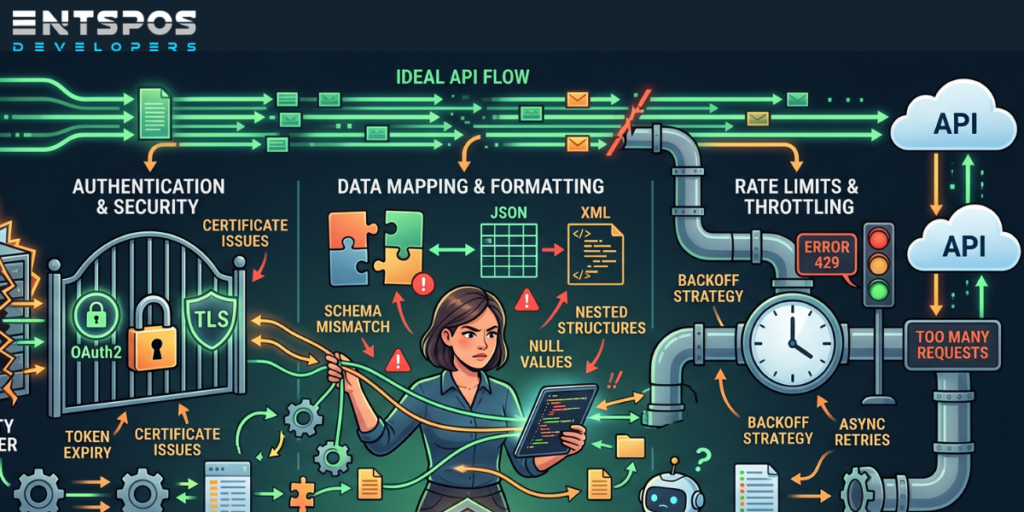
Nazima 6:31 pm May 11, 2026 One API Glitch, Zero Users: The Night We Lost 5,000 Signups It happened during a midnight deployment. Traffic was climbing fast. Signups were rolling in every second. Then suddenly—everything stopped. No crash screen. No dramatic server explosion. Just silence. Our third-party API integration had failed quietly in the background, and within minutes, nearly 5,000 new users were stuck in limbo. That night taught me something every developer, startup founder, and engineering team eventually learns: A product can have great code, a polished UI, and solid infrastructure—but weak API integration can still break the entire experience. After working with multiple teams and debugging integrations across different products, I’ve noticed the same problems appear again and again. Here are the biggest API integration challenges that cause real damage—and the fixes that actually work. 1. Authentication Problems That Break Everything Authentication failures are one of the most common integration issues, especially when multiple services are involved. A token expires unexpectedly. Permissions change. OAuth scopes mismatch. Suddenly every request starts returning 401 Unauthorized.Why this becomes a serious problem OAuth implementations differ between providers API keys and secrets get exposed or mismanaged Multi-tenant systems create permission confusion Refresh-token logic is often poorly handled What helped us We centralized authentication instead of handling it separately across services. Tools like Okta, Firebase Auth, or Auth0 simplify token management and role control. Adding middleware-level validation also helped us detect authentication failures before requests reached critical services. The result: authentication-related API errors dropped dramatically. 2. API Version Changes That Quietly Break Your App One of the most frustrating things about third-party APIs is that providers update them constantly. Sometimes an endpoint changes format. Sometimes a field disappears. Sometimes pagination behavior changes without warning. Your code keeps running—but your data becomes unreliable. Common versioning problems Breaking changes during active releases Legacy clients depending on old response structures Frontend parsing failures from modified payloads Different teams using different API versions Better approach Use explicit API versioning strategies such as: httpAPI-Version: 2.0 Contract-testing tools like Stoplight or Swagger/OpenAPI validation help ensure both teams follow the same schema expectations. Versioning discipline prevents “silent failures” that are hard to detect in production. 3. Rate Limits That Destroy Performance During Growth Most APIs look generous during development. Then launch day arrives. Suddenly your application exceeds quota limits, retries explode, and users start experiencing delays or failed actions. Why rate limits spiral out of control No monitoring of API quotas Aggressive retry loops multiplying requests Shared API keys across environments Confusion between per-user and global limits What works in production Redis caching for repeated requests Exponential backoff with jitter Queue systems for burst handling Monitoring tools like Prometheus or Grafana Caching alone can reduce external API costs and massively improve reliability under load. 4. Data Structure Mismatches That Waste Hours This is where integrations become exhausting. One API sends dates as timestamps. Another sends strings. Nested JSON structures differ slightly between environments. Nullable fields suddenly appear. Small inconsistencies create large debugging sessions. Typical causes Unannounced schema changes Mixed protocols like REST and gRPC Weak validation layers Inconsistent serialization formats Smarter solution Validate and normalize incoming data aggressively. Tools like: JSON Schema validators Zod tRPC TypeScript type enforcement …help catch issues before they spread into your application. Strong typing turns unpredictable integrations into maintainable systems. 5. Latency and Timeouts That Slowly Kill User Experience Not every failure is immediate. Sometimes APIs technically work—but they respond too slowly. A few extra seconds across multiple services can completely ruin application performance. What usually causes it Too many network hops Slow upstream providers Missing timeout configurations Serverless cold starts No circuit-breaker protection Better architecture choices Use gRPC where low latency matters Add request timeouts everywhere Implement circuit breakers Use reverse proxies like Envoy Example: javascriptfetch(url, {timeout: 5000}) Without proper timeout handling, slow services can consume resources indefinitely. 6. Reliability Problems From Third-Party Providers This is the harsh reality of modern software: Your application may be stable, but your dependencies might not be. Even providers promising “99.9% uptime” still experience outages, degraded performance, or regional failures. Hidden reliability risks No fallback providers Vendor lock-in Compliance conflicts across regions Regional API outages How teams reduce risk Add failover mechanisms Use API gateways like Zuplo Mirror critical services across cloud providers Design systems to degrade gracefully The goal is not perfect uptime. The goal is ensuring one provider failure does not take down your entire product. 7. Weak Testing That Lets Bugs Reach Production Many API integrations pass staging tests and still fail in real-world traffic. Why? Because mocks rarely behave exactly like production systems. Common testing gaps Outdated mock responses Missing edge-case payloads Unrealistic load simulations No contract testing between services Better testing stack WireMock for realistic API stubs Artillery or k6 for load testing Consumer-driven contract testing Chaos engineering practices One properly simulated failure scenario can prevent weeks of production damage. Final Thought: API Integration Is Infrastructure, Not Glue Code A lot of teams treat integrations like a secondary task. But APIs are no longer just connectors between services—they are part of your product’s core infrastructure. The strongest applications are not the ones with the most features. They are the ones that remain reliable when authentication fails, providers change behavior, traffic spikes, or dependencies go down. If you improve even one area today—authentication, testing, versioning, monitoring, or resilience—you reduce the chance of your next deployment turning into a disaster. Because in modern software, users rarely see the API. But they always feel it when it breaks. Recent Posts
Patterns of design that every designer should know

Shameer 8:51 am January 9, 2026 Patterns of Design That Every Developer Should Know Code writing is simple. Writing code that is elegant, scalable, and maintainable is the real challenge. Most developers have faced situations where adding a small feature breaks half the system or where debugging spaghetti code at 2 a.m. feels inevitable. Design patterns exist to solve exactly these problems. They are not academic theory; they are practical, battle-tested solutions that improve how we think about software design. Design patterns give developers a shared language. Saying, “Let’s use a factory pattern here” instantly communicates a complete architectural idea without long explanations. What Are Design Patterns? Design patterns are reusable blueprints for solving common software design problems. Just as architects don’t reinvent doorways for every building, developers shouldn’t reinvent solutions to problems that have already been solved many times. Patterns help you build systems that are easier to understand, extend, and maintain. Essential Design Patterns Every Developer Should Know 1. Singleton Pattern Problem Your application needs exactly one instance of a class, such as a database connection, configuration manager, or logging service. Solution The Singleton pattern ensures a class has only one instance and provides a global access point to it. When to Use Shared resources like database connections Centralized configuration Caching or thread pools Caution Singletons can hide dependencies and make testing difficult. In many cases, dependency injection is a cleaner alternative. 2. Factory Pattern Problem Object creation logic is complex or tightly coupled to your code. Solution The Factory pattern delegates object creation to a separate class or method. Example A notification system that sends messages via email, SMS, or push notifications. A NotificationFactory decides which notifier to create based on user preferences. Why It Matters Cleaner code Easier to extend New features require minimal changes 3. Observer Pattern Problem Multiple parts of your application need to react to changes in another object without being tightly coupled. Solution Observers subscribe to a subject and are notified automatically when changes occur. Where You’ve Seen It JavaScript event listeners React state updates Pub/sub systems Benefits Loose coupling Scalable event handling Cleaner communication between components 4. Strategy Pattern Problem You need to swap algorithms or behaviors at runtime. Solution Encapsulate each algorithm in its own class and make them interchangeable through a common interface. Example A payment system supporting credit cards, PayPal, and cryptocurrencies. Each payment method is a strategy implementing the same interface. Result Flexible behavior Easy runtime switching Cleaner conditional logic 5. Decorator Pattern Problem You want to add behavior to objects dynamically without modifying their structure. Solution The Decorator pattern wraps objects and adds new behavior, like layers added to a cake. Common Use Cases Authentication and authorization Logging and monitoring Caching Middleware pipelines 6. Adapter Pattern Problem You must integrate incompatible interfaces, such as third-party APIs or legacy systems. Solution The Adapter pattern converts one interface into another that your system expects. Example Providing a unified interface for payment gateways like Stripe, PayPal, and Square so your application logic remains consistent. 7. Repository Pattern Problem Business logic and data access code are tightly coupled. Solution The Repository pattern abstracts data access and treats data sources as collections of domain objects. Why Developers Love It Easier unit testing with mock repositories Centralized data access logic Ability to switch databases without rewriting business logic 8. Dependency Injection Pattern Problem Classes create their own dependencies, leading to tight coupling and poor testability. Solution Dependencies are provided externally instead of being created inside the class. Impact Modular code Easier testing Improved maintainability Used by modern frameworks such as Spring, Angular, and .NET Core. Choosing the Right Pattern Not every problem needs a design pattern. Overengineering is a real risk. Use patterns when: The problem is recurring You expect future changes The complexity justifies the abstraction Avoid patterns when: A simple solution works You’re adding patterns just to look clever The pattern increases complexity unnecessarily Design Patterns in the Real World Modern frameworks are built on design patterns. React’s Context API uses Provider and Observer concepts. Express middleware follows a chain-style processing model. TypeScript decorators are a direct application of the Decorator pattern. Understanding these patterns makes frameworks easier to use and reason about. Next Steps Learning design patterns is about recognition, not memorization. Start small. Pick one or two patterns you can apply immediately. Refactor existing code, observe the improvements, and build intuition over time. Final Thoughts Design patterns are more than code templates. They represent decades of shared experience from developers solving the same problems repeatedly. Mastering these core patterns helps you write code that is easier to understand, easier to maintain, and easier to extend. Good developers write code. Great developers write code that other developers enjoy working with. Design patterns are one of the most powerful tools on that journey. Recent Posts