
Brain–Computer Interfaces (BCI): Connecting the Human Brain with Machines
Shameer 10:23 am January 23, 2026 Brain–Computer Interfaces (BCI): Connecting the Human Brain with Machines Introduction Imagine controlling a computer cursor, typing a message, or moving a robotic arm using nothing but your thoughts. This isn’t science fiction—it’s the reality of brain–computer interfaces (BCI), one of the most transformative technologies at the intersection of neuroscience, artificial intelligence, and human–machine interaction. BCI technology matters now more than ever. As our world becomes increasingly digital, the ability to create seamless connections between the human brain and machines opens unprecedented possibilities. For healthcare, BCIs offer hope to patients with paralysis and neurological conditions. For AI development, they provide direct pathways to understand human cognition. For human augmentation, they represent the next frontier in how we interact with technology and enhance our capabilities. The global BCI market is experiencing rapid growth, driven by advances in machine learning, miniaturized sensors, and a deeper understanding of neural signals. From medical rehabilitation centers to gaming studios, from military research labs to consumer tech companies, organizations worldwide are exploring how BCIs can revolutionize the way humans and machines collaborate. What is a Brain–Computer Interface (BCI)? A brain–computer interface is a direct communication pathway between the brain’s electrical activity and an external device, typically a computer or robotic system. Unlike traditional interfaces that require physical movement—typing on a keyboard, clicking a mouse, or speaking commands—BCIs bypass conventional neuromuscular pathways entirely. The basic working principle follows a straightforward process: brain signals are captured through sensors, these signals are processed and translated by algorithms, and finally, they’re converted into commands that control external devices. Think of it as a translator that converts the language of neurons into the language of machines. When you think about moving your hand, specific patterns of electrical activity occur in your brain’s motor cortex. A BCI system detects these patterns, interprets your intent, and can trigger a corresponding action—whether that’s moving a cursor on a screen, controlling a wheelchair, or operating a prosthetic limb. BCI Architecture Overview Understanding how BCIs work requires examining their four main components: Brain Signal Acquisition The first step involves capturing electrical signals from the brain. This can be done through various methods: Non-invasive techniques like electroencephalography (EEG) use sensors placed on the scalp to detect electrical activity. EEG is safe and accessible but captures weaker signals with lower spatial resolution. Invasive methods involve surgically implanted electrodes that sit directly on or within brain tissue. These provide much clearer, more detailed signals but carry surgical risks and require medical procedures. Signal Processing and Feature Extraction Raw brain signals are noisy and complex. Advanced signal processing algorithms filter out interference, identify relevant patterns, and extract meaningful features. This step removes artifacts caused by eye movements, muscle activity, or external electrical noise. Machine Learning and AI Interpretation Modern BCI systems rely heavily on artificial intelligence to decode brain signals. Machine learning models are trained to recognize specific neural patterns associated with particular intentions or mental states. Deep learning algorithms can identify subtle patterns that improve accuracy over time, adapting to individual users’ unique brain signatures. Output Devices and Applications The final component translates interpreted signals into real-world actions. Output devices include computer interfaces, prosthetic limbs, wheelchairs, communication systems, and even smart home controls. The sophistication of these outputs continues to advance as BCI technology matures. Types of Brain–Computer Interfaces BCIs are categorized based on how signals are acquired from the brain: Invasive BCIs Invasive BCIs require neurosurgery to place electrodes directly on the brain’s surface or within brain tissue. These systems offer the highest signal quality and precision. Advantages: Superior signal resolution, precise control, ability to detect complex neural patterns, stable long-term performance. Limitations: Surgical risks, potential for infection or immune response, high cost, ethical concerns about brain modification. Real-world example: The Utah Array, used in research studies, has enabled paralyzed individuals to control robotic arms with remarkable dexterity. Patients have successfully performed complex tasks like drinking from a cup or playing simple games. Semi-Invasive BCIs These systems position electrodes inside the skull but outside the brain tissue itself, sitting on the surface of the brain beneath the skull. Advantages: Better signal quality than non-invasive methods, lower risk than fully invasive approaches, reduced tissue damage. Limitations: Still requires surgery, may experience signal degradation over time, limited commercial availability. Real-world example: Electrocorticography (ECoG) systems are sometimes used during epilepsy treatment to map brain function before surgery. Non-Invasive BCIs Non-invasive BCIs use external sensors, most commonly EEG caps or headbands, to detect brain activity from outside the skull. Advantages: No surgery required, safe and reversible, lower cost, easier to deploy at scale, suitable for consumer applications. Limitations: Weaker signals, lower spatial resolution, susceptible to noise and artifacts, generally limited to simpler commands. Real-world example: Consumer EEG headsets like those used in meditation apps or basic gaming controls demonstrate how non-invasive BCIs can enter everyday life. Key Characteristics of BCI Systems Several defining characteristics set BCI technology apart: Real-time brain signal processing is essential for BCIs to function effectively. The system must detect, interpret, and respond to brain signals with minimal delay—typically within milliseconds—to create a natural user experience. Direct human–machine interaction occurs without any physical movement or sensory pathway. This represents a fundamentally different mode of communication compared to any previous technology in human history. Dependence on AI and machine learning means BCIs improve through use. As systems gather more data, algorithms become better at interpreting individual users’ unique neural patterns, leading to increased accuracy and responsiveness. Ethical and privacy considerations are paramount. BCIs access our most private domain—our thoughts. Questions about data ownership, consent, mental privacy, and the potential for misuse require careful ethical frameworks and robust regulatory oversight. Advantages Medical rehabilitation and restoration: BCIs offer transformative potential for individuals
Quantum Computing: Bridging Today’s Technology with Tomorrow’s Possibilities
Shameer 5:36 pm October 27, 2025 Quantum Computing: The Future of TechnologyA New Kind of ComputingQuantum computing marks a revolutionary leap from traditional computing. Instead of relying on simple binary bits — 0s and 1s — quantum computers use qubits, which can exist in multiple states at once. This unique property comes from the strange but powerful laws of quantum mechanics. The Power of Superposition and EntanglementTwo key principles make quantum computers extraordinary:Superposition: A qubit can represent both 0 and 1 at the same time, allowing it to perform many calculations simultaneously.Entanglement: Qubits can be deeply connected, so changing one instantly affects the other — even if they are far apart.Together, these properties enable quantum computers to tackle problems that would take classical computers thousands of years to solve. The Challenges AheadDespite its promise, quantum computing faces significant hurdles:Qubit Stability: Qubits are extremely sensitive and can lose their quantum state easily due to environmental noise (a problem called decoherence).Error Correction: Developing reliable systems to correct quantum errors is still a major research challenge. The Road Forward: Hybrid SystemsIn the near future, we’ll see hybrid quantum-classical systems, where quantum processors act as powerful sidekicks to classical computers — handling only the tasks they’re best at. This collaboration will bridge today’s computing with tomorrow’s possibilities. Recent Posts
From Chatbots to Smart Toys: AI’s Rapid Growth in China
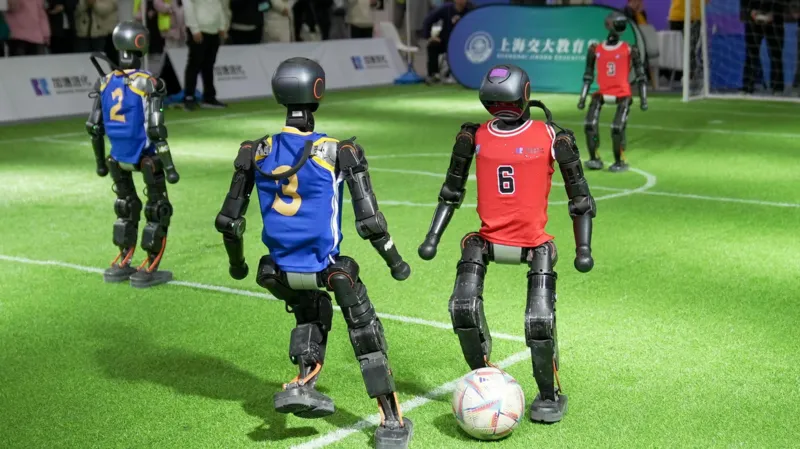
Shameer 11:49 am March 22, 2025 Eight-year-old Timmy sat hunched over his chessboard, deep in concentration, as he faced off against his robotic opponent powered by artificial intelligence. But this wasn’t a high-tech lab or an AI exhibition — this robot had become part of his everyday life, residing on the coffee table of his Beijing apartment. The first night the robot arrived, Timmy gave it a warm hug before heading to bed. He hasn’t named it yet, but he already sees it as more than just a machine. “It’s like a little teacher or a little friend,” he said, as he proudly showed his mother his next move. Moments later, the robot blinked its digital eyes and chimed: “Congrats! You win.” As it began resetting the board for a new game, it continued in Mandarin: “I’ve seen your ability. I will do better next time.” China’s AI Ambitions China is embracing artificial intelligence as it pushes to become a global tech superpower by 2030. The breakthrough Chinese chatbot, DeepSeek, which grabbed headlines in January, was just a glimpse of this ambition. Investment is flooding into AI enterprises, driving fierce domestic competition. Currently, more than 4,500 firms are developing and selling AI technologies. Schools in Beijing plan to introduce AI courses for primary and secondary students later this year, and universities are expanding spots for students eager to study the field. “This is an inevitable trend. We will co-exist with AI,” said Timmy’s mother, Yan Xue. “Children should become familiar with it as early as possible. We shouldn’t reject it.” Yan Xue was convinced the robot’s $800 price tag was a worthy investment because it not only plays chess but also teaches Go, another complex strategy game. The robot’s creators are already planning to add a language tutoring feature. China’s Race for Tech Dominance Perhaps this aligns with what the Chinese Communist Party envisioned back in 2017 when it declared AI as “the main driving force” behind the nation’s progress. Now, President Xi Jinping is heavily investing in AI as China’s economy contends with US-imposed tariffs. Beijing has outlined a plan to pour 10 trillion yuan ($1.4 trillion) into tech advancements over the next 15 years, competing with Washington for supremacy in AI and other emerging technologies. The government’s latest political assembly has given AI funding another boost, following the creation of a 60 billion yuan AI investment fund in January, just days after the US imposed tighter export controls on advanced chips and added more Chinese firms to its trade blacklist. However, DeepSeek has demonstrated that Chinese companies can navigate these obstacles, stunning Silicon Valley and industry experts who didn’t expect China to catch up so quickly. Engineering Success and Global Surprise Tommy Tang, who has spent the past six months promoting his firm’s chess-playing robot, is no stranger to international surprise. Timmy’s robot hails from his company, SenseRobot, which gained fame in 2022 when its advanced model defeated chess Grand Masters. “Parents always ask the price first, then they ask where I’m from. When I say China, there are always a couple of seconds of silence,” Tang said with a smile. SenseRobot has now sold over 100,000 units and secured a deal with the US retail giant Costco. China’s secret weapon may be its young talent. In 2020, over 3.5 million Chinese students graduated with degrees in science, technology, engineering, and mathematics (STEM) — more than any other country. As Xi told party leaders recently, “Building strength in education, science, and talent is a shared responsibility.” Abbott Lyu, vice president of AI toy-maker Whalesbot, echoes this sentiment. “We’ve accumulated talent and technology for decades,” Lyu said, as a child controlled a roaring dinosaur toy through code assembled on a smartphone. Whalesbot’s products aim to teach coding to children as young as three, with toys priced as low as $40. China’s AI industry isn’t slowing down. Companies are driven by a spirit of innovation and cost-efficiency. Tang revealed that SenseRobot initially faced challenges with the cost of its robotic arm, which would have pushed the price to $40,000. By integrating AI into the manufacturing process, they reduced it to just $1,000. “This is innovation,” he said. “Artificial engineering is now embedded into our production.” As China applies AI on a massive scale, its ambitions extend beyond consumer products. The government envisions AI-powered humanoid robots assisting its rapidly aging population and enhancing factory productivity. President Xi has set “technological self-reliance” as a cornerstone of China’s future, preparing the nation for a marathon to lead the AI revolution. “DeepSeek means the world knows we are here,” said 26-year-old engineer Yu Jingji at a recent AI fair in Shanghai, where robots played football in front of excited crowds. “The future belongs to AI, and China is ready.” China’s AI journey is just beginning, but with its rapidly growing talent pool, bold investments, and culture of relentless innovation, the race is heating up. The dragons are rising, and the world is watching. Recent Posts