
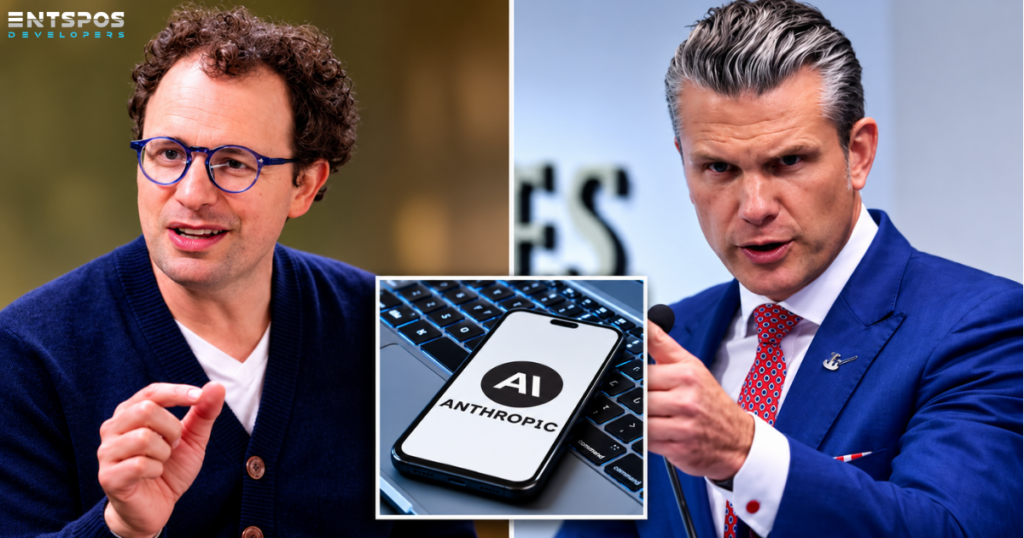
Judge Blocks Pentagon’s Blacklist of Anthropic, Calls It Unlawful
A U.S. federal judge has blocked the Pentagon from blacklisting Anthropic, the AI company behind Claude. The court found that the government’s decision to label Anthropic a “supply-chain risk” was unlawful and violated key legal protections.
The ruling was issued by U.S. District Judge Rita F. Lin in the Northern District of California.
Why Did the Pentagon Target Anthropic?
The dispute began over how the U.S. military wanted to use Anthropic’s AI technology.
Anthropic has restrictions on certain high-risk uses of Claude, including some applications involving autonomous weapons and mass surveillance. The company did not agree to give the Pentagon unrestricted access for all military uses.
The disagreement became more serious when Defense Secretary Pete Hegseth designated Anthropic as a “supply-chain risk.” The designation led to restrictions on Anthropic’s work with the Department of Defense and affected companies working with the government that used Anthropic’s technology.
Why Did the Court Reject the Government’s Action?
The judge identified three major legal problems.
First, First Amendment:
The court found that the government’s actions were connected to Anthropic’s public position on AI safety and its policies for how its technology could be used.
Second, Due Process:
The court found that Anthropic was not given the required legal process before facing such serious restrictions.
Third, Administrative Law:
The court found that the government had not provided a sufficient legal and factual basis for calling Anthropic a supply-chain security risk because of a disagreement over AI-use policies.
What Happens to Anthropic Now?
The ruling blocks the challenged restrictions against Anthropic.
The company can continue working with federal agencies and businesses that have government contracts, subject to normal procurement rules.
However, the ruling does not mean that the Pentagon must buy Anthropic’s AI products. The government can still decide which AI systems it wants to use.
The key point is that the government cannot use a broad supply-chain-risk designation as a way to punish a company without a proper legal basis.
Why Is This Important for the AI Industry?
The case highlights a growing conflict between AI companies that want limits on how their technology is used and governments that want greater access to advanced AI for defense and national security.
It also raises an important question about how much control AI companies should have over the use of their technology.
For the wider AI industry, the ruling shows that companies can establish safety and usage policies, while government agencies must still operate within constitutional and legal limits.
Bottom Line
The Pentagon wanted greater access to Anthropic’s AI technology, while Anthropic wanted to keep restrictions on certain military uses.
The dispute eventually led to the government labeling Anthropic a supply-chain risk.
The court ruled that the government’s response went too far.
The decision does not give Anthropic control over government procurement. Instead, it reinforces the principle that the government must have a proper legal and factual basis when restricting a technology company.
As artificial intelligence becomes more important to defense and national security, the Anthropic case could play an important role in future debates over AI safety, government power, and the rights of technology companies.