
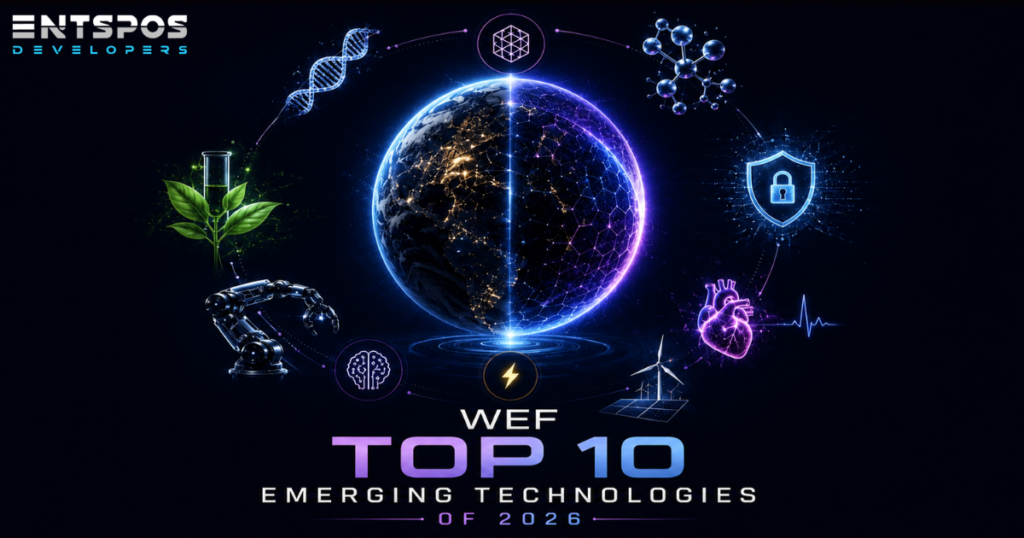
WEF Top 10 Emerging Technologies of 2026: The Innovations Shaping the Next Decade
The World Economic Forum’s report on Top 10 Emerging Technologies highlights new innovations that could change energy systems, healthcare, cybersecurity, materials science and sustainability. These are not just ideas in research labs. They are technologies that are moving closer to being used in the world and could affect industries, governments and everyday life over the next decade.
The World Economic Forums report is important this year because it balances ideas with practical uses. The report covers infrastructure, medicine, climate solutions and digital security, not artificial intelligence. This broader view shows where the next wave of innovation is likely to happen.
Everything-to-Grid Energy
Everything-to-Grid also called X2G is a system that lets vehicles, smart buildings and data centers send unused electricity back into the grid when demand is high. Of energy flowing in only one direction the system becomes more flexible and interactive. This matters because modern power grids are under a lot of pressure. As electricity demand grows, from transportation and digital infrastructure X2G could help reduce blackouts and improve energy stability. It also turns assets into active parts of the energy network. The Everything-to-Grid Energy technology is an innovation that could make a big difference.
Direct Lithium Extraction
Direct lithium extraction is an cleaner way to get lithium from brine. Traditional extraction methods use evaporation ponds. Take months while this new approach can complete the process in hours. This is important for the vehicle and battery industries. Lithium is still essential for vehicles, energy storage and portable electronics so a more efficient extraction method could strengthen supply chains while reducing water use and environmental damage. Direct Lithium Extraction is a technology for the future of energy.
Personalized mRNA Cancer Vaccines
Personalized mRNA cancer vaccines are designed to match the characteristics of a patient’s tumor. Of using a one-size-fits-all treatment doctors can potentially create a vaccine that trains the immune system to target specific cancer cells. This approach could be a step forward in oncology. It combines the flexibility of mRNA technology with precision medicine opening the door to treatments that’re more targeted and potentially more effective. Personalized mRNA Cancer Vaccines are an innovation in cancer treatment.
Exosome Drug Delivery
Exosomes are natural particles that can carry biological material between cells. Scientists are now exploring how they can be used to deliver drugs precisely inside the body. The appeal of exosome-based delivery is accuracy. By helping medicine reach the cells more efficiently this method could reduce side effects and improve treatment outcomes for a range of diseases. Exosome Drug Delivery is a technology that could improve healthcare.
Low-Carbon Ammonia Synthesis
Ammonia is widely used in fertilizers. Is also being explored as a clean fuel. The challenge is that traditional ammonia production is energy-intensive and produces emissions. Carbon ammonia synthesis aims to solve that problem. If successful it could support sustainable agriculture and create a cleaner pathway for industrial energy use. Low-Carbon Ammonia Synthesis is a technology for reducing emissions.
Structural Battery Composites
Structural battery composites combine strength and energy storage in the material. In terms a part of a vehicle, aircraft or device could also function as a battery. This could change product design in a way. Lighter materials usually mean efficiency, longer battery life and improved performance especially in transportation and electronics. Structural Battery Composites are an innovation that could transform industries.
Osmotic Power Systems
Osmotic power systems generate electricity from the difference in salt concentration between water and seawater. It is an energy method based on a natural process that happens where rivers meet the sea. Although still emerging this technology could become useful in regions looking for stable low-carbon power. Its biggest advantage is that it taps into a natural energy gradient. Osmotic Power Systems are a technology for renewable energy.
Engineered Living Therapeutics
Engineered living therapeutics use cells or microbes to treat disease from within the body. Of simply delivering a drug the therapy itself becomes biologically active and adaptive. This field could transform medicine by making treatments smarter and more responsive. It is especially promising for conditions that’re difficult to manage with traditional pharmaceuticals. Engineered Living Therapeutics are an innovation in medicine.
Quantum Simulation for Drug Discovery
Quantum simulation uses computing models to study molecular behavior and chemical reactions more accurately. In drug discovery this could help scientists test treatments faster and with greater precision. The practical value is huge. Drug development is expensive and time-consuming better simulation tools could reduce costs improve success rates and speed up access to new medicines. Quantum Simulation for Drug Discovery is a technology for the future of healthcare.
Lattice-Based Cryptography
Lattice-based cryptography is a class of encryption designed to withstand attacks from quantum computers. As quantum computing advances current encryption systems may eventually become vulnerable. This is one of the urgent technologies on the list for cybersecurity professionals. Businesses, governments and SaaS platforms will need quantum- encryption to protect sensitive data in the years ahead. Lattice-Based Cryptography is a technology for cybersecurity.
Why This Report Matters
The World Economic Forum’s list is important because it reflects where scientific progress is becoming commercially relevant. These technologies are not trends. They are part of a shift toward resilient infrastructure, cleaner industry and future-ready digital systems. The report highlights where new skills, products and security strategies will matter most.
The World Economic Forum’s Top 10 Emerging Technologies of 2026 offers more than a snapshot of innovation. It shows how the future is being built across energy, health, materials and cybersecurity at the time. These technologies point toward a world that’s more connected, more efficient and more prepared, for the challenges ahead. The companies and professionals who understand these shifts early will be better positioned to lead in the decade.